
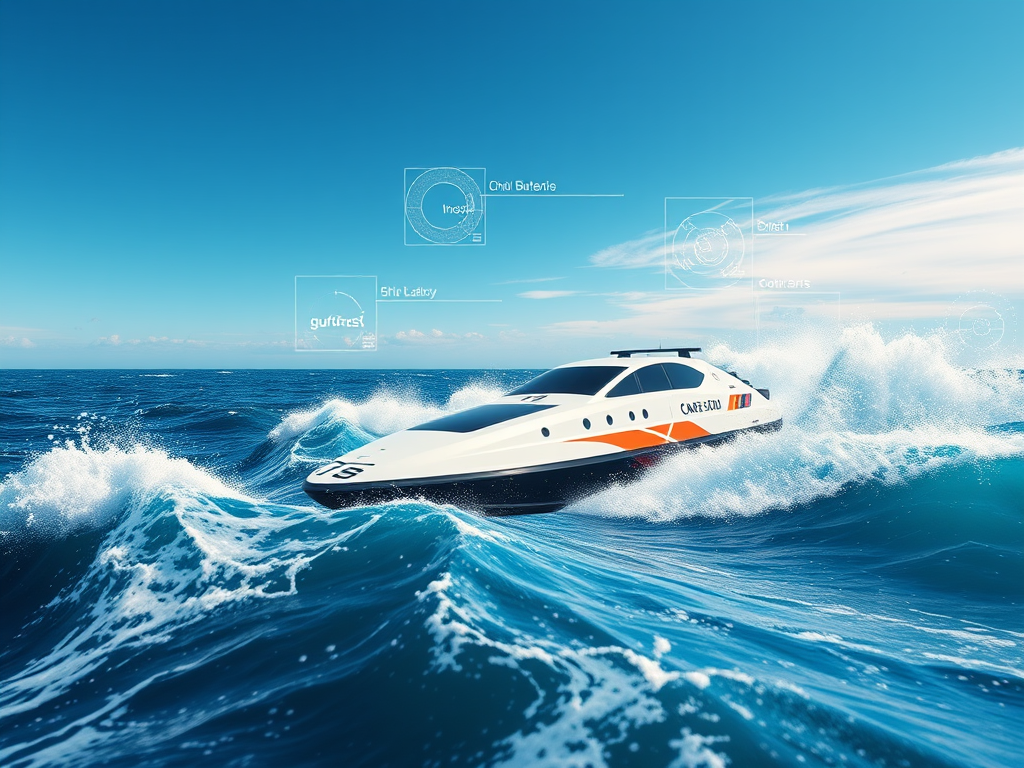
There are many different approaches to simulating the operation of ships in general and unmanned surface vehicles in particular. Compared with the theory in “Design and validation of an unmanned surface vehicle simulation model“, this article focuses on simplifying the formula but fully explaining the factors, increasing computing efficiency and is a theoretical description of a simulation program that has run in practice. That is the CEMA 1000 simulation program.
The program does not redefine the physical principles but is already an internal function of the simulation library module of the 3D programming platform. What it does is to calculate the thrust, buoyancy, environmental resistance, and forces and/or torques caused by waves and wind acting on the ship.
There are some equivalent problems, for example, the 6 degrees of freedom in “Design and validation of an unmanned surface vehicle simulation model” are equivalent to 3 degrees of freedom in the object space, plus 3 degrees of freedom in the world space of the modeled platform. In addition, the wave design is completely intuitive and easy to interpret, but generates realistic ocean waves when applying the Gerstner wave model where the waves are not sinusoidal but must be deformed due to the influence of gravitational acceleration.
The full documentation is here

Leave a Reply